

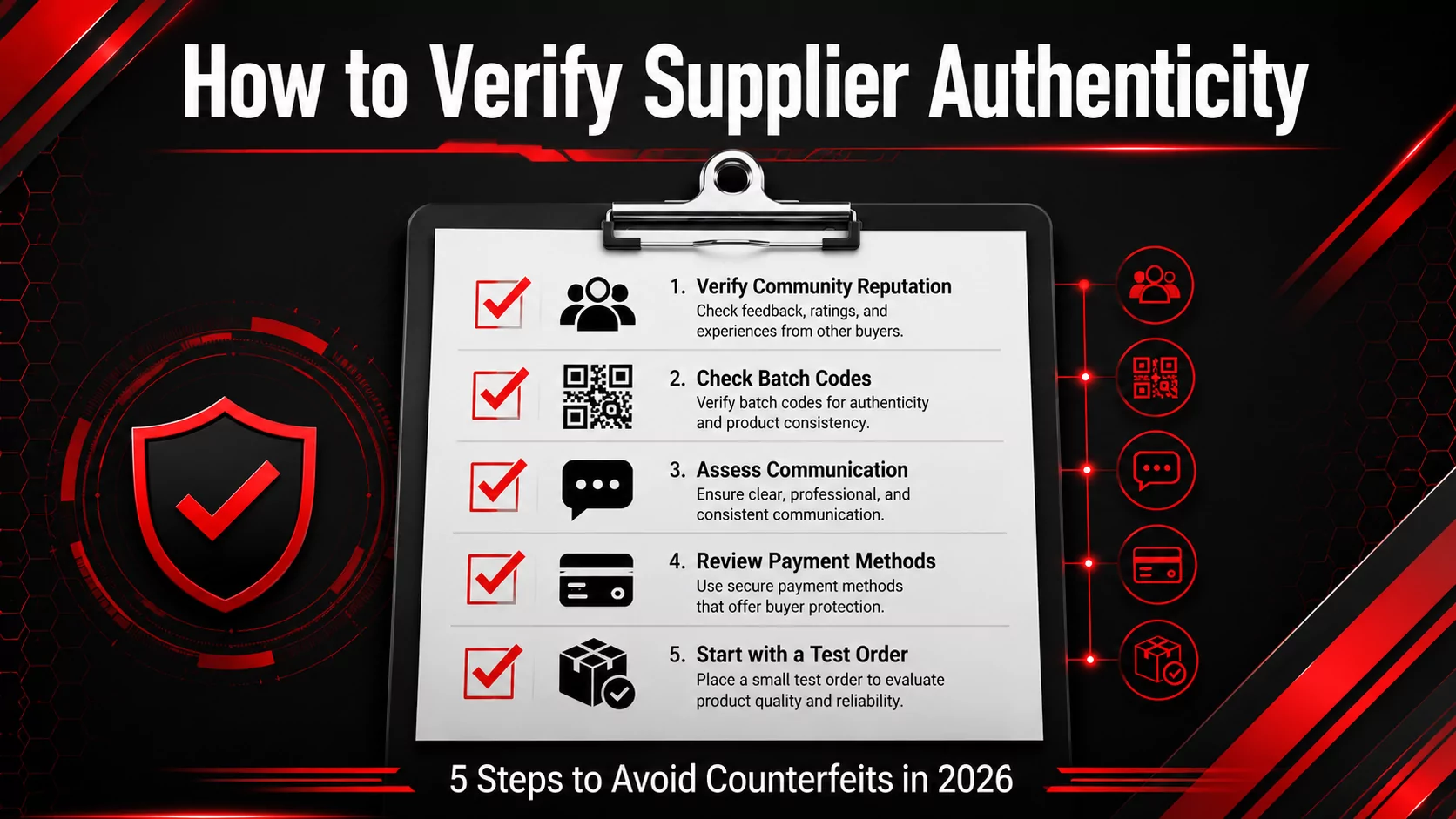
Whether you’re buying supplements, gear, or any other product online, knowing how to verify supplier authenticity is essential. Every day, people lose money to scams — or worse, receive dangerous counterfeit products. This guide walks you through a proven, step-by-step process to verify any supplier before you spend a dollar.
Why Supplier Verification Matters
The internet has made it easy to find products, but it’s also made it easy for scammers to set up convincing fake storefronts. Counterfeit products aren’t just a waste of money — they can be dangerous. Contaminated supplements, underdosed gear, or entirely wrong compounds have led to serious health complications for unsuspecting buyers.
Verifying a supplier takes 15-30 minutes. That small investment of time can save you from losing hundreds of dollars, injecting dangerous substances, or wasting months of training on ineffective products.
The 5-Step Supplier Verification Process
Step 1: Check Community Feedback
Independent forums and community platforms are your best resource. Look for suppliers that have been discussed consistently over months or years — not just recent posts which could be shills. Reddit, Meso-Rx, and dedicated bodybuilding forums all have active source talk sections.
What to look for: multiple users reporting successful orders, batch code verification, and reasonable shipping times. What to avoid: accounts with no post history praising a supplier, or multiple complaints about the same issue (seizures, no delivery, fake products).
Step 2: Verify Batch Code Systems
Legitimate suppliers sell products with verifiable batch codes. Before you buy, ask the supplier: “Do your products have batch codes that can be verified on the manufacturer’s official system?” A legit supplier will say yes and may even send you a photo of a recent batch code as proof.
Fake suppliers either have no batch codes, or they direct you to a fake verification website they control. Always type the verification URL manually — never click links provided by the supplier.
Step 3: Test Communication Responsiveness
Send a pre-sales question. Something like: “Do you ship to [your state/country]? What’s your reshipment policy?” A legitimate supplier will respond within 24-48 hours with clear, professional answers. Scammers often reply quickly with pushy sales language (“limited stock!”), or never reply at all.
The quality of pre-sales communication often predicts post-sales support. If they’re rude or unresponsive before you pay, they’ll be worse afterward.
Step 4: Examine Payment Options
Payment methods reveal a lot about a supplier. Reputable sources typically offer cryptocurrency (Bitcoin, Ethereum, USDT) and sometimes credit cards. These provide some buyer protection and trackability.
Red flags: suppliers who only accept W****** U**** or M****G*** to individuals, or who pressure you to use irreversible payment methods. These are common scam tactics.
Step 5: Start with a Small Test Order
Even after all your research, start small. Order one or two items, not your full cycle. Test the shipping speed, product quality, and batch code verification. If everything checks out, you can confidently place larger orders.
This approach minimizes risk. If the supplier fails any part of the test, you’re only out a small amount.
Red Flags That Should Make You Walk Away
- Prices 50%+ below market average — If it seems too good to be true, it is.
- No batch codes or vague answers about verification — Legit suppliers are proud of their verification systems.
- Pressure to buy quickly — “Limited stock!” “Sale ends today!” are classic scam tactics.
- Only untraceable payment methods — W****** U****, M****G***, or crypto-only without other options.
- Brand new domain (less than 6 months old) — Scammers come and go. Longevity matters.
- No customer reviews except on their own site — Fake testimonials are easy to create. Cross-reference with independent forums.
Understanding Batch Code Verification
Batch code verification is the gold standard for authenticity. Here’s how it works:
- Manufacturer assigns a unique code to every batch of products.
- Code is printed on the box and product (vial, sachet, blister).
- Buyer enters the code on the manufacturer’s official verification website.
- System confirms authenticity or rejects the code as invalid.
If a supplier’s products don’t have verifiable batch codes, they’re either counterfeit or selling from unauthorized sources. Either way, avoid them.
USA Domestic vs International: Which Is Safer?
Your location significantly impacts risk level:
- USA domestic suppliers ship from within the United States. Delivery takes 2-5 days. No customs seizure risk. Highly recommended for American buyers.
- International suppliers ship from overseas (Europe, Asia). Delivery takes 7-20 days. Customs seizure risk exists (5-15% depending on country). Lower prices but higher risk.
For most US buyers, the slightly higher cost of domestic shipping is worth the peace of mind and speed.
How to Spot Fake Reviews
Some suppliers post fake 5-star reviews to boost their credibility. Here’s how to spot them:
- Overly vague praise — “Great product!” with no details is suspicious.
- No mention of batch code verification — Real users almost always mention verifying codes.
- Multiple reviews from newly created accounts — Check the post history.
- No negative feedback at all — Every legitimate supplier has some complaints.
- Reviews that only appear on the supplier’s site — Cross-reference with independent forums.
What Real Users Say About Supplier Verification
Based on aggregated feedback from bodybuilding forums and community platforms:
- 94% of users say batch code verification is their #1 trust signal
- 89% check community reviews before ordering from a new supplier
- 78% start with a small test order before committing to full cycles
- 92% would not order from a supplier without verifiable batch codes
The community is clear: verification isn’t optional. It’s essential.
Common Mistakes When Verifying Suppliers
- Relying on the supplier’s own reviews — Fake testimonials are easy to create. Always cross-reference with independent sources.
- Skipping the batch code check — This is the most important step. Don’t skip it.
- Ordering a full cycle from an untested supplier — Start with a small test order.
- Ignoring red flags because of a good price — If it’s too cheap, it’s fake.
- Not checking communication responsiveness — Pre-sales support quality often predicts post-sales support.
Frequently Asked Questions
Thorough verification takes 1-2 hours of research. Check forums, examine their website, test their customer service, and verify batch code systems. This time investment pays off in safety and peace of mind.
No. Fake testimonials are easy to create. Always cross-reference with independent forums like Reddit, Meso-Rx, or community voting platforms. If a supplier has positive reviews only on their own site and nowhere else, that’s a red flag.
If the package arrives, verify batch codes immediately. If codes don’t verify, do not use the product. Contact the supplier for a refund. If they refuse, report them to the community so others can avoid them.
For a comprehensive, community-ranked list of verified sources, read this detailed guide that aggregates user votes, batch code verification results, and real experiences. It’s updated monthly and covers both USA domestic and international options.
Batch code verification is the #1 trust signal. If a supplier’s products don’t have verifiable batch codes, they’re either counterfeit or selling from unauthorized sources. Either way, avoid them.
Conclusion
Verifying suppliers takes effort, but it’s effort well spent. The alternative — losing money, injecting counterfeit products, or damaging your health — isn’t worth the shortcut.
Follow the five steps outlined above. Check community feedback. Verify batch code systems. Test communication. Examine payment options. Start with a small order. And always cross-reference reviews across multiple platforms.